What's the biggest factor in HDD wear-out?
October 13th, 2016, 7:48
For a good while now, I've been wondering about what power policies are best for making an HDD last as long as possible.
Basically, I'm wondering about two specific factors that seem to be the most important.
-Total cumulative spinning time
-Spin-up/Spin-down cycles.
Since I started having computers at home in the early 2000s (sure took a long time), I don't think I ever had an HDD die on my where I couldn't identify some incident that accelerated it's failure. In every case there was something that most probably killed it, whether it was dropping it, a power problem, etc. I can't say for certain that any of them just wore out and died of old age. Maybe one or two, but neither case is set in stone.
Generally, ever since I found the pertinent configuration menus, I prefered an "always-on" power policy for a number of reasons, and that didn't seem to affect the HDD's life expectancy. Power consumption wasn't and isn't a big concern for me.
It's only recently that I started to activate automatic sleep times for disks... and becoming concerned about the impact the spin-up/down cycles may have on the life expectancy of the disk.
Also, I acquired an external USB3 hdd, Toshiba Canvio Basics 3TB, which, annoyingly, disengages after 3 measly minutes, already stacking a whoopping 5600+ cycles in just a couple of months.
Generally speaking, what kills a disk faster? my disks seem to have been doing well with an always on policy, but I can't claim say that's statistically relevant.
Basically, I'm wondering about two specific factors that seem to be the most important.
-Total cumulative spinning time
-Spin-up/Spin-down cycles.
Since I started having computers at home in the early 2000s (sure took a long time), I don't think I ever had an HDD die on my where I couldn't identify some incident that accelerated it's failure. In every case there was something that most probably killed it, whether it was dropping it, a power problem, etc. I can't say for certain that any of them just wore out and died of old age. Maybe one or two, but neither case is set in stone.
Generally, ever since I found the pertinent configuration menus, I prefered an "always-on" power policy for a number of reasons, and that didn't seem to affect the HDD's life expectancy. Power consumption wasn't and isn't a big concern for me.
It's only recently that I started to activate automatic sleep times for disks... and becoming concerned about the impact the spin-up/down cycles may have on the life expectancy of the disk.
Also, I acquired an external USB3 hdd, Toshiba Canvio Basics 3TB, which, annoyingly, disengages after 3 measly minutes, already stacking a whoopping 5600+ cycles in just a couple of months.
Generally speaking, what kills a disk faster? my disks seem to have been doing well with an always on policy, but I can't claim say that's statistically relevant.
Re: What's the biggest factor in HDD wear-out?
October 15th, 2016, 17:38
I was going to say the biggest factor is one well-known manufacturer. 
Re: What's the biggest factor in HDD wear-out?
October 16th, 2016, 4:03
ROLMFAO 
jono-ats wrote:I was going to say the biggest factor is one well-known manufacturer.
Re: What's the biggest factor in HDD wear-out?
October 18th, 2016, 12:26
That's all?
Re: What's the biggest factor in HDD wear-out?
October 18th, 2016, 17:16
Enterprise drives are designed for 24/7 usage. Desktop are not designed for 24/7 usage and would therefore typically spin up/ down when idle.
Good read
http://knowledge.seagate.com/articles/e ... uage=en_US
Good read
http://knowledge.seagate.com/articles/e ... uage=en_US
Re: What's the biggest factor in HDD wear-out?
October 18th, 2016, 17:38
Enterprise Drives: Fact or Fiction?
https://www.backblaze.com/blog/enterpri ... liability/
https://www.backblaze.com/blog/enterpri ... liability/
Overall, I argue that the enterprise drives we have are treated as well as the consumer drives. And the enterprise drives are failing more.
So, Are Enterprise Drives Worth The Cost?
From a pure reliability perspective, the data we have says the answer is clear: No
Re: What's the biggest factor in HDD wear-out?
October 18th, 2016, 18:18
fzabkar wrote:Enterprise Drives: Fact or Fiction?
https://www.backblaze.com/blog/enterpri ... liability/Overall, I argue that the enterprise drives we have are treated as well as the consumer drives. And the enterprise drives are failing more.
So, Are Enterprise Drives Worth The Cost?
From a pure reliability perspective, the data we have says the answer is clear: No
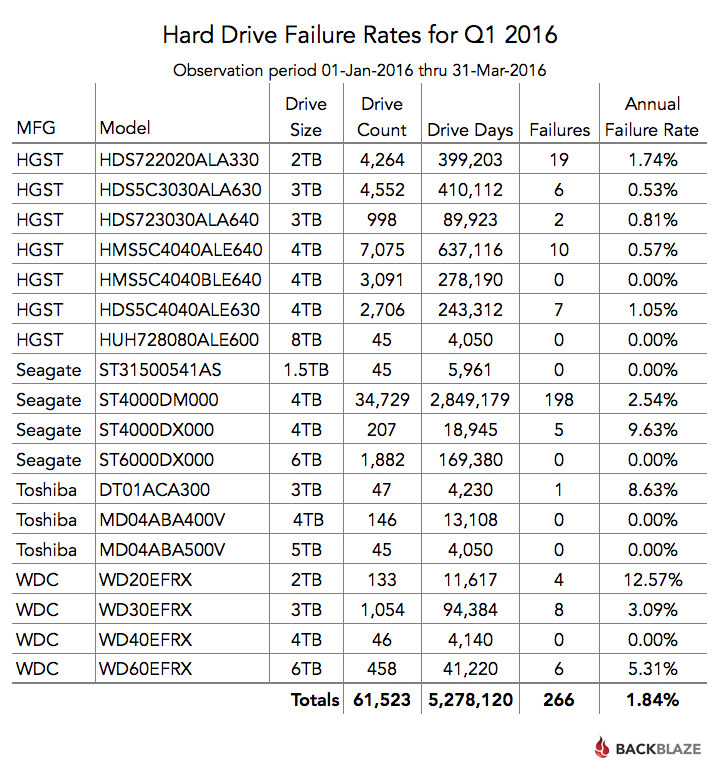
Judging by the models they using (from their annual reports) they are not qualified to say anything about enterprise drives
They only use HGST enterprise drives, they have zero Seagate or WD enterprise models in their stock.
Re: What's the biggest factor in HDD wear-out?
October 18th, 2016, 18:50
Re: What's the biggest factor in HDD wear-out?
October 18th, 2016, 18:58
FWIW, I tried to make sense of the differences between WD's enterprise and consumer grade drives here:
https://community.wd.com/t/questions-about-the-wd1003fbyz-i-just-received/17519
https://community.wd.com/t/questions-about-the-wd1003fbyz-i-just-received/17519
AIUI, we have a consumer grade 5400 RPM ("IntelliPower") HDD with enterprise-class spindle motor balancing ("3D Active Balance Plus"), whereas the enterprise grade 7200 RPM HDDs are limited to a Stabletrac (tm) screw.
Re: What's the biggest factor in HDD wear-out?
October 19th, 2016, 2:23
Hi Doomer ,Guru and guys
I am promoting Toshiba Enterprise hard disks to my customers.Its heavy well built drive. So far there is not single failure.
What you think about Toshiba ? Hdd industry is consolidating ad we have only Seagate ,WD and Toshiba as main players. ( hitachi is now a WD company)
I have heard that Toshiba manufactures hard disks in WD factories.
Besides Toshiba is having unique architecture ( firmware is in CP's in pcb) , so recovery is nearly impossible if original pcb is lost /damaged.
There is no way to recreate rom like WD .
what is your observation about Toshiba? Pls. give your expert opinion.
Thank you
I am promoting Toshiba Enterprise hard disks to my customers.Its heavy well built drive. So far there is not single failure.
What you think about Toshiba ? Hdd industry is consolidating ad we have only Seagate ,WD and Toshiba as main players. ( hitachi is now a WD company)
I have heard that Toshiba manufactures hard disks in WD factories.
Besides Toshiba is having unique architecture ( firmware is in CP's in pcb) , so recovery is nearly impossible if original pcb is lost /damaged.
There is no way to recreate rom like WD .
what is your observation about Toshiba? Pls. give your expert opinion.
Thank you
Re: What's the biggest factor in HDD wear-out?
October 19th, 2016, 2:51
I would buy REAL HGST and then probably WD.
Seagate is crap
Seagate is crap
Re: What's the biggest factor in HDD wear-out?
October 19th, 2016, 7:42
Is HGST and Hitachi are different?
HGST thin hard disk is most dangerous we don't have a single success so far.
HGST thin hard disk is most dangerous we don't have a single success so far.
Re: What's the biggest factor in HDD wear-out?
October 19th, 2016, 10:21
athena wrote:I am promoting Toshiba Enterprise hard disks to my customers.
Toshiba Enterprise drives are basically Fujitsu Enterprise drives with a different label.
It's hard to say if they are good or not, because there are not so many Toshibas/Fujitsus here but if you can get statistics about Fujitsu Enterprise drives - you will get the picture.
Last edited by Doomer on October 19th, 2016, 10:23, edited 1 time in total.
Re: What's the biggest factor in HDD wear-out?
October 19th, 2016, 10:22
athena wrote:Is HGST and Hitachi are different?
no
athena wrote:HGST thin hard disk is most dangerous we don't have a single success so far.
Thin drives are all crap
Re: What's the biggest factor in HDD wear-out?
October 19th, 2016, 14:43
athena wrote:Is HGST and Hitachi are different?
HGST thin hard disk is most dangerous we don't have a single success so far.
HGST thin disks ARE crap, but we still get success in ~90% of cases!
Re: What's the biggest factor in HDD wear-out?
October 19th, 2016, 14:53
So, generally speaking, if you use consumer level drives, you do advise to let them spin down and up again, rather than just keep them going on, even if that means stacking up a lot of cycles?
I don't mind the thread going into more general reliablity issues, but my main interest here was "continuous rotation vs spin-up/down". I realize this will depend on particular models and the such, but... dunno, you know more than me, so I was hoping you would be able to assess this.
As I said, my limited personal experience, always with consumer drives, over the last 15 years, barely ever letting disks spin down didn't seem to affect them negatively, while I've heard plenty of troubles from other people havign their disks die on them, who, in all cases did let them sleep.
Out of all the things involved in a spin-up/down, the servo seems like the most likely to suffer from all the starting and stopping, since the arm mostly does what it does during normal seeking, just a little farther. But that's just a non-expert observation. What do you think?
A very different matter is my stupid external 3-min load cycle drive...
I don't mind the thread going into more general reliablity issues, but my main interest here was "continuous rotation vs spin-up/down". I realize this will depend on particular models and the such, but... dunno, you know more than me, so I was hoping you would be able to assess this.
As I said, my limited personal experience, always with consumer drives, over the last 15 years, barely ever letting disks spin down didn't seem to affect them negatively, while I've heard plenty of troubles from other people havign their disks die on them, who, in all cases did let them sleep.
Out of all the things involved in a spin-up/down, the servo seems like the most likely to suffer from all the starting and stopping, since the arm mostly does what it does during normal seeking, just a little farther. But that's just a non-expert observation. What do you think?
A very different matter is my stupid external 3-min load cycle drive...
Re: What's the biggest factor in HDD wear-out?
October 19th, 2016, 15:06
radorn wrote:As I said, my limited personal experience, always with consumer drives, over the last 15 years, barely ever letting disks spin down didn't seem to affect them negatively, while I've heard plenty of troubles from other people havign their disks die on them, who, in all cases did let them sleep.
My own limited personal experience is similar to yours. I prefer to keep my drives spinning 24/7.
Re: What's the biggest factor in HDD wear-out?
October 19th, 2016, 15:17
I believe motor failures are rare these days. The past 15 years have seem enormous advances in technology and areal density, so the old stalwarts lasted longer than today's drives. Everything has gotten smaller, more fragile and more critical in operation, whereas tolerances used to let things just carry on in the past. Today, if you look crosswise at some drives, you end up with head and/or media damage. Reliability data is very hard to come by so I don't think you will find more insights into reliability than provided by BackBlaze's data. It doesn't matter; what matters is having the discipline and processes to make and manage regular back-ups because all drives will fail when you are least prepared to deal with it, and will have the gravest consequences possible.Out of all the things involved in a spin-up/down, the servo seems like the most likely to suffer from all the starting and stopping, since the arm mostly does what it does during normal seeking, just a little farther.
Re: What's the biggest factor in HDD wear-out?
October 20th, 2016, 23:19
Maybe not a total failure, but, with all the starting and stopping, I guess it could accelerate it's becoming jittery, which could trow off the data timing? as jitter gets worse, the electronics would find it increasingly difficult to sync to the signal from the heads, eventually becoming impossible.
Just theorizing, of course, but seems reasonable to me.
Just theorizing, of course, but seems reasonable to me.
Re: What's the biggest factor in HDD wear-out?
October 21st, 2016, 9:37
One point against spin up/down is the possibility of head/media degradation due to ramp load / unload.
Powered by phpBB © phpBB Group.