Question on PCB chip identification
June 20th, 2024, 9:31
Hiya. Newbie here. I see that next to the BIOS chip it is marked as U12 on the pcb. Are all those marked as 'Uxx' bios chips as well? I was looking at a WD PCB and do see U21 and U23 quite close to the MOTOR IC. U22 seems to be next to the RAM/MEMORY.
What chip does Q1 marked on the HDD pcb identify?
I am looking high and low for MOSFET/FET chips but am not able to identify one. Any advice?
this PCB is from a WD2060- 771640-002
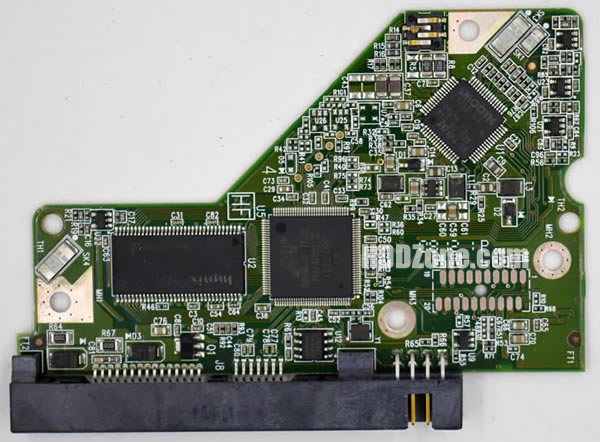
What chip does Q1 marked on the HDD pcb identify?
I am looking high and low for MOSFET/FET chips but am not able to identify one. Any advice?
this PCB is from a WD2060- 771640-002
Re: Question on PCB chip identification
June 20th, 2024, 12:11
No. Usually only U12 is for the BIOS.BIOS chip it is marked as U12 on the pcb. Are all those marked as 'Uxx' bios chips as well?
Some boards use two chips, at U12 and U14 if remember well.
For board transfers, always swap the chip at U12, and the one at U14 if it does not suffice.
Some boards, especially those from enterprise grade drives, also may store the BIOS in the MCU controller.
Re: Question on PCB chip identification
June 20th, 2024, 14:13
Most of the 5-pin ICs are op amps.
U22, U23 and U24 amplify the signals from shock sensors SK3 and SK4. This forms the rotational vibration sensing circuit.
Hard drive shock sensors:
https://www.hddoracle.com/viewtopic.php?p=19489#p19489
Q1 is an NPN pass transistor in a 3.3V linear regulator. This regulator is controlled by the SMOOTH L7251 motor controller IC. This IC controls the spindle motor, voice coil and onboard linear and switchmode power supplies.
This is the datasheet for an earlier L7250 motor controller:
https://www.hddoracle.com/viewtopic.php?p=19489#p19489
Tutorial - Linear and Switchmode Regulators used in HDDs:
https://www.hddoracle.com/viewtopic.php?f=59&t=231
There is a 6-pin IC near inductor L1. This is the MOSFET chopper for the Vcore power supply.
L3 and D2 form the -5V supply for the preamp.
I believe U9 (near the HDA connector) is a logic gate.
There is an unpopulated area consisting of U7, U25 and U26. This is reserved for a barometric pressure sensor and its two op amps.
Barometric Pressure Sensor:
https://www.hddoracle.com/viewtopic.php?f=100&t=3140
If you need answers to more questions, several people have written extensive tutorials at hddoracle.com.
U22, U23 and U24 amplify the signals from shock sensors SK3 and SK4. This forms the rotational vibration sensing circuit.
Hard drive shock sensors:
https://www.hddoracle.com/viewtopic.php?p=19489#p19489
Q1 is an NPN pass transistor in a 3.3V linear regulator. This regulator is controlled by the SMOOTH L7251 motor controller IC. This IC controls the spindle motor, voice coil and onboard linear and switchmode power supplies.
This is the datasheet for an earlier L7250 motor controller:
https://www.hddoracle.com/viewtopic.php?p=19489#p19489
Tutorial - Linear and Switchmode Regulators used in HDDs:
https://www.hddoracle.com/viewtopic.php?f=59&t=231
There is a 6-pin IC near inductor L1. This is the MOSFET chopper for the Vcore power supply.
L3 and D2 form the -5V supply for the preamp.
I believe U9 (near the HDA connector) is a logic gate.
There is an unpopulated area consisting of U7, U25 and U26. This is reserved for a barometric pressure sensor and its two op amps.
Barometric Pressure Sensor:
https://www.hddoracle.com/viewtopic.php?f=100&t=3140
If you need answers to more questions, several people have written extensive tutorials at hddoracle.com.
Re: Question on PCB chip identification
June 20th, 2024, 14:52
fzabkar wrote:This is the datasheet for an earlier L7250 motor controller:
https://www.hddoracle.com/viewtopic.php?p=19489#p19489
Sorry, that should have been ...
https://www.recomb-omsk.ru/published/SC/html/scripts/doc/L7250E.pdf
Re: Question on PCB chip identification
June 21st, 2024, 2:13
fzabkar wrote:Most of the 5-pin ICs are op amps.
U22, U23 and U24 amplify the signals from shock sensors SK3 and SK4. This forms the rotational vibration sensing circuit.
Hard drive shock sensors:
https://www.hddoracle.com/viewtopic.php?p=19489#p19489
Q1 is an NPN pass transistor in a 3.3V linear regulator. This regulator is controlled by the SMOOTH L7251 motor controller IC. This IC controls the spindle motor, voice coil and onboard linear and switchmode power supplies.
This is the datasheet for an earlier L7250 motor controller:
https://www.hddoracle.com/viewtopic.php?p=19489#p19489
Tutorial - Linear and Switchmode Regulators used in HDDs:
https://www.hddoracle.com/viewtopic.php?f=59&t=231
There is a 6-pin IC near inductor L1. This is the MOSFET chopper for the Vcore power supply.
L3 and D2 form the -5V supply for the preamp.
I believe U9 (near the HDA connector) is a logic gate.
There is an unpopulated area consisting of U7, U25 and U26. This is reserved for a barometric pressure sensor and its two op amps.
Barometric Pressure Sensor:
https://www.hddoracle.com/viewtopic.php?f=100&t=3140
If you need answers to more questions, several people have written extensive tutorials at hddoracle.com.
Very important post fzabkar
We have training program for new trainee engineers & we have downloaded hddoracle site .It is like wikipidia of hard disk & data recovery. Tons of information.
your posts are so useful on a day today basis.
Thanks a lot.
Re: Question on PCB chip identification
June 21st, 2024, 4:27
Hi all, thank you for the reply.
Why would they need to put a NPN 3.3 V transistor when the Vin in the last 3 pins already carry the 3.3V? Is the Q1 trying to step down a 12v or 5v to the 3.3V?
Why would they need to put a NPN 3.3 V transistor when the Vin in the last 3 pins already carry the 3.3V? Is the Q1 trying to step down a 12v or 5v to the 3.3V?
Re: Question on PCB chip identification
June 21st, 2024, 4:54
- supply cables usually don't deliver 3.3V, only 5 and 12.
- of course it is stepped down from 5V, less loss.
pepe
- of course it is stepped down from 5V, less loss.
pepe
Re: Question on PCB chip identification
June 21st, 2024, 5:05
pepe wrote:- supply cables usually don't deliver 3.3V, only 5 and 12.
- of course it is stepped down from 5V, less loss.
pepe
Thank you for the reply.
Lots to learn about!!
Re: Question on PCB chip identification
June 21st, 2024, 10:09
Question again!!!!!
is the 3.3v only managed and used by L7251?
is the 3.3v only managed and used by L7251?
Re: Question on PCB chip identification
June 21st, 2024, 11:17
The 3.3V Vio supply is used by the MCU and possibly the serial flash memory. (You need to check the datasheet for the latter.) The MCU and SMOOTH chip communicate via a serial bus which is probably at 3.3V levels. I suspect that the preamp also uses 3.3V. There is also a second Vio voltage of 2.5V.
Re: Question on PCB chip identification
June 21st, 2024, 12:04
Getting quizzed further by your above replies,
what makes you believe that U9 (near the HDA connector) is a logic gate?
Why couldn't the manufacturers just label the chip. For a newbie like me, the U9 and the U22 ( SK amplifier ) look exactly the same.
This is really becoming more and more interesting!!!
what makes you believe that U9 (near the HDA connector) is a logic gate?
Why couldn't the manufacturers just label the chip. For a newbie like me, the U9 and the U22 ( SK amplifier ) look exactly the same.
This is really becoming more and more interesting!!!
Re: Question on PCB chip identification
June 21st, 2024, 12:16
I am basing my identification of U9 purely on memory.
The markings on surface mounted components are usually abbreviations, although in most cases there is no obvious relationship to the real part number.
This is my go-to site for marking codes:
http://markingcodes.com/
The markings on surface mounted components are usually abbreviations, although in most cases there is no obvious relationship to the real part number.
This is my go-to site for marking codes:
http://markingcodes.com/
Powered by phpBB © phpBB Group.