Data recovery and disk repair questions and discussions related to old-fashioned SATA, SAS, SCSI, IDE, MFM hard drives - any type of storage device that has moving parts
Post a reply

Dead 2.5" WD800VE PATA - help

May 23rd, 2011, 7:10

Hi,

I have a old noteboot hard drive which now is dead, doesn't spin up at all.
Model: Western Digital Scorpio WD800VE
80GB
2.5" PATA
WD P/N: WD800VE-07HDT0

Any "classic" component I could check?
If I can find a donor drive can the PCB be replaced directly on this old model? or do I need to swap some components on the PCB?

Thanks, hope someone can provide some input :)
:idea:

Re: Dead 2.5" WD800VE PATA - help

May 23rd, 2011, 8:03

Hi,

Can you take a picture of the PCB and show it here?
You can buy a new PCB and swap ROM (if external), but that really depends if the problem is really related with PCB or with PCB only.

Re: Dead 2.5" WD800VE PATA - help

May 23rd, 2011, 12:31

Please see attached pics
Attachments
IMG_0397.JPG
IMG_0395.JPG
IMG_0392.JPG

Re: Dead 2.5" WD800VE PATA - help

May 23rd, 2011, 12:46

You can check diodes to see if any is damaged.

ROM chip is external (U12), but it's not easy to move if you don't have experience and I would not recommend to move it.

Re: Dead 2.5" WD800VE PATA - help

May 23rd, 2011, 12:47

The ROM is at U12, but it's one of those nasty things with pads on the bottom rather than legs, by the look of it. Quite tricky to remove.

Re: Dead 2.5" WD800VE PATA - help

May 23rd, 2011, 12:50

Damm everyones so quick at beating me to it lol

L1 & L2 look like there TVS.
Is there damage on L1 looks like a line on it?

PCimage out of couriosity how do you remove the U12 like that?

Loki

Re: Dead 2.5" WD800VE PATA - help

May 24th, 2011, 2:53

Thanks for your suggestions, will check L1 & L2. What should I measure on these two? any other components I should check?

Thanks :D

Re: Dead 2.5" WD800VE PATA - help

May 24th, 2011, 2:55

loki wrote:

PCimage out of couriosity how do you remove the U12 like that?

Loki


Decent de-soldering equipment :-)

Re: Dead 2.5" WD800VE PATA - help

May 24th, 2011, 6:30

I don't see any TVS diodes on the PCB.

L1 and L2 are inductors, not TVS diodes. They should measure 0 ohms on a multimeter. Do not remove them.

If you would like to check a few voltages, then you can do so with the board removed from the drive. I'd measure the voltages between ground and L1, L2, D7, D8, Q8 (DA). Be very careful not to slip with your probe, as you will do serious damage.

Re: Dead 2.5" WD800VE PATA - help

May 24th, 2011, 6:43

loki wrote:


PCimage out of couriosity how do you remove the U12 like that?

Loki


Decent de-soldering equipment
loki wrote:

PCimage out of couriosity how do you remove the U12 like that?

Loki


Decent de-soldering equipment :-)


I have a hot air station so i'll try & find an old pcb to practice on.

Re: Dead 2.5" WD800VE PATA - help

May 24th, 2011, 16:00

Good idea!

Practice, as they say, makes perfect. :-)

Re: Dead 2.5" WD800VE PATA - help

May 25th, 2011, 16:52

Been doing some measurement of voltages between ground, please see attached picture.
Anything that make sense? Hope someone has a good suggestion or additional measurements:)

Thanks
Attachments
IMG_0392.JPG

Re: Dead 2.5" WD800VE PATA - help

May 25th, 2011, 18:15

Q8 is the pass transistor for the +3.3V linear regulator. It supplies the Vio rail for the Marvell MCU (88i6540-BAM1), and it also powers the hynix SDRAM and Atmel serial flash memory. Its tab is connected to the +5V supply, which is also measuring OK.

Diodes D1-D6 appear to be Schottky rectifiers. I'm not certain, but I believe they rectify the three phases of the spindle motor to provide an emergency retract voltage. When the drive loses power, the motor becomes a generator and supplies a decaying voltage to the SMOOTH controller to allow the heads to be parked in a controlled manner.

Q6, D7, and L2 appear to constitute a 1.4V switchmode DC-DC converter which supplies +1.4V (Vcore) to the MCU. That said, there is an inconsistency in your measurements. AFAICT, the uppermost pin of L2 is connected to the cathode (striped end) of D7, which means that both should measure the same.

Q3, L1, and D8 appear to constitute a negative DC-DC converter. If I'm right, then the anode (non-striped) end of D8 should be the negative supply for the preamp (inside the HDA). It appears that this area of the circuit is faulty.

My next step would be to perform some resistance measurements (in the absence of power). The preamp connector is J1, and is located at the far left side of the PCB. Set your meter on the 200 ohms range and measure the resistances between ground and each of the heavier pads (pins 2,4,6,8,10,12). One or more pins will be connected to ground (0 ohms). Similarly, determine which pin connects to +5V. Finally, determine which pin, if any, connects to the anode of D8. This will be the negative supply pin.

Our next step will depend on what you find.

References:

HY57V641620ETP-6, Hynix, 64Mb SDRAM, 1M x 4Bank x 16, 3.3V:
http://www.hynix.com/datasheet/pdf/dram ... 41620E(L_S)T(P)%20Series(Rev1.0).pdf

AT25F1024, SPI Serial Memory, Atmel, 2.7V - 3.6V, 1Mbit (131,072 x 8):
http://www.atmel.com/dyn/resources/prod ... oc1440.pdf

Re: Dead 2.5" WD800VE PATA - help

May 25th, 2011, 19:36

If the heads are parked on the platters (not uncommon), you are barking up the wrong tree, looking for an electrical fault. Just sayin'.

Jon

Re: Dead 2.5" WD800VE PATA - help

May 25th, 2011, 19:43

If the heads are parked on the platters (not uncommon), you are barking up the wrong tree, looking for an electrical fault. Just sayin'.

Jon

Re: Dead 2.5" WD800VE PATA - help

May 25th, 2011, 20:20

If the OP's measurements are accurate, then it is clear that there is a board fault. This fault may have other consequences (eg preamp failure), but there is nothing to suggest that the OP's drive has a stiction fault.

Re: Dead 2.5" WD800VE PATA - help

May 25th, 2011, 23:52

Here's reference voltages from a working PCB:

L1 0V
L2 1.393
D7 1.4/0.3 (anode/cathode)
D8 0.001/0.123
Q8 4.0/5.06/3.35 (BCE, I think)

Jon

Re: Dead 2.5" WD800VE PATA - help

May 26th, 2011, 2:29

Sorry, your correct that L2 measure 1.4 volt as D7:)

J1 pin:
GND: 1, 8
5v: 6
D8: 10

Repeated jono-ats measurements:
L1 0.0
L2 1.4
D7 1.4 / -0.0006
D8 0.0001/ 0.095
Q8 3.93/5.08/3.23

D7 cathode which is different from your measures? 0volt on my PCB. The resistence between D7 and GND is 0 ohm. D7 cathode is short circuit to GND on my PCB.

Thank you for your big effort so far, really appreciated!

Re: Dead 2.5" WD800VE PATA - help

May 26th, 2011, 10:08

I wouldn't pay much attention to the millivolt readings that I measured. The meter jumped around a bit, and I probably didn't give enough attention to the placement of the decimal point on some of the really low readings.

Insofar as I can see, your measurements don't indicate a major PCB problem.

In my opinion, the lack of an obvious electrical fault strongly suggests that stiction may be the culprit here. It is good to have opinions and to disagree from time to time -- makes for more interesting reading . . . :D

Re: Dead 2.5" WD800VE PATA - help

May 27th, 2011, 5:29

karlshoj wrote:Sorry, your correct that L2 measure 1.4 volt as D7:)

J1 pin:
GND: 1, 8
5v: 6
D8: 10

Repeated jono-ats measurements:
L1 0.0
L2 1.4
D7 1.4 / -0.0006
D8 0.0001/ 0.095
Q8 3.93/5.08/3.23

D7 cathode which is different from your measures? 0volt on my PCB. The resistence between D7 and GND is 0 ohm. D7 cathode is short circuit to GND on my PCB.

D7 is the flywheel diode. It's anode should be grounded, not the cathode.

http://upload.wikimedia.org/wikipedia/c ... fr.svg.png

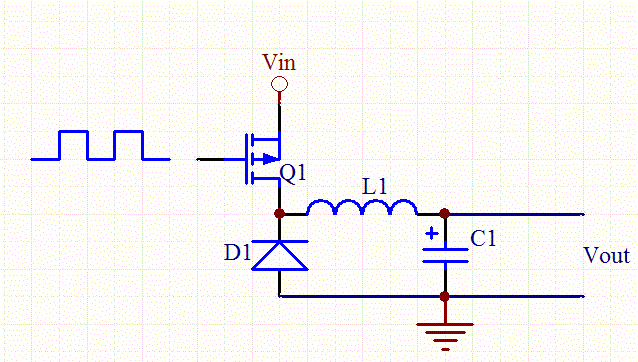
AFAICT, the Vcore supply is based on a "buck converter" topology:
http://www.daycounter.com/LabBook/BuckC ... ematic.gif

It appears that pins 2 and 4 of J1 may be connected to the voice coil. Pins 6, 8 and 10 are the +5V, ground, and -5v (?) supplies for the preamp.

The fact that the negative supply measures 0V, even on a good board, suggests to me that this particular switchmode supply may not power up correctly without a load (ie the preamp). If the problem is indeed stiction, then you should hear or feel buzzing or vibration as the drive attempts to kickstart the motor. Furthermore, you should be able to detect "voltage activity" at the motor terminals while this is happening.
Post a reply