fzabkar wrote:
the -5V supply would come up briefly after power-on and then switch off again within a second or two.
I checked this, and the voltage doesn't appear for even a split second. It's possible there's a slight spike to -0.16 volts maximum, but that could just be noise from the power supply connection. After that, the voltage stays at around 0.1 volts. The board behaves this way regardless of whether it's connected to the HDA or not.
fzabkar wrote:
The only other possibility that comes to mind is whether the drive is configured to Power Up In Standby (PUIS).
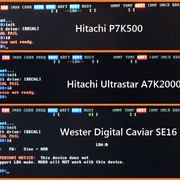
I'd never seen this feature in action before, so I took a nearly 20-year-old Western Digital hard drive, whose sticker indicated that the appropriate contacts needed to be jumpered to enable PUIS. I also took a Core2 Duo motherboard of roughly the same age. The hard drive didn't spin up with PUIS enabled, and to my surprise, this motherboard froze during POST and reported a hard drive failure

I also took an old Hitachi P7K500, disconnected the flat flex cable going to the spindle motor, and connected the drive to the computer in this state. The motherboard behaved exactly the same – it froze during POST and reported a hard drive failure. But to my surprise, it didn't freeze or report anything when I connected my non-functioning A7K2000 hard drive.
Another thing that surprised me is that MHDD and Victoria are completely useless and uninformative in such situations. All Victoria can do is show a blank hard drive passport, but at least it can detect that the hard drive is in standby mode.
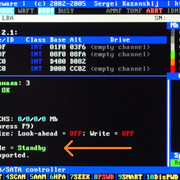
But I use a newer HP computer, and it had no problems running this Western Digital drive with PUIS enabled. This same computer was the one complaining about the Hitachi A7K2000 being faulty.
So this Hitachi drive either has some weird, non-standard implementation of the PUIS function, or it's just... faulty.
******
I checked the preamplifier's resistance. The +5 volt line has about 60K ohms, while the -5 volt line has infinite resistance. However, in diode check mode, these two lines have roughly the same voltage drop - around 480 and 450 mV, respectively, if the black probe is positioned at the higher potential. So, at a minimum, there were no open or shorted circuits.
I also tried replacing the broken capacitor with a likely working 10μF, 10V one from a scrap motherboard. The capacitor had minor damage from being torn out; in my experience, this rarely disrupts the device's operation, but perhaps this minor damage was sufficient. Unfortunately, replacing the capacitor didn't help; the drive still won't spin up.
I also flashed a dump I found here in the files section, from a hardware-identical Deskstar 7k2000, to the board. It also didn't help; the drive won't spin up, and -5 volts don't appear on the board.
The last thing I want to try is unsoldering the inductor and applying -5 volts to the load using another faulty hard drive as a power source. This might be enough to trick the VCM into thinking the required voltage is being generated and the drive can continue spinning up. I don't know if this is a good idea, but I don't think it can do any harm.
fzabkar wrote:
transfer the ROM to a compatible donor PCB
This is likely the only viable option. Unfortunately, I've only found two options for donor hard drives so far: one for the same price as the 7k2000, but with a board in even worse condition and also non-functional, and one drive for double the price, but with a fully functional board. If I were absolutely certain my drive was mechanically perfect, I'd buy this donor, but for now, I'm risking spending half the price of a working, but slightly used, hard drive on this venture, only to end up with two faulty drives. So, it looks like this drive will have to be shelved until better times come.



 FAQ
FAQ Search
 Login
Login Register
 HDDGURU FILES

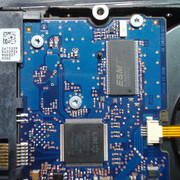
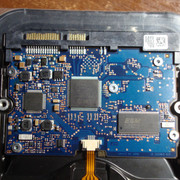
 But it's not working because it won't spin up. While deciding whether to buy it or not, I noticed that some SMD components were missing from the board. When I received it, I looked closely and saw that one capacitor was missing and another had been torn off the board. This circuit looks like a voltage regulator, so it's no surprise the drive isn't working
 I want to try fixing this board, but I can't figure out why it's still not working.