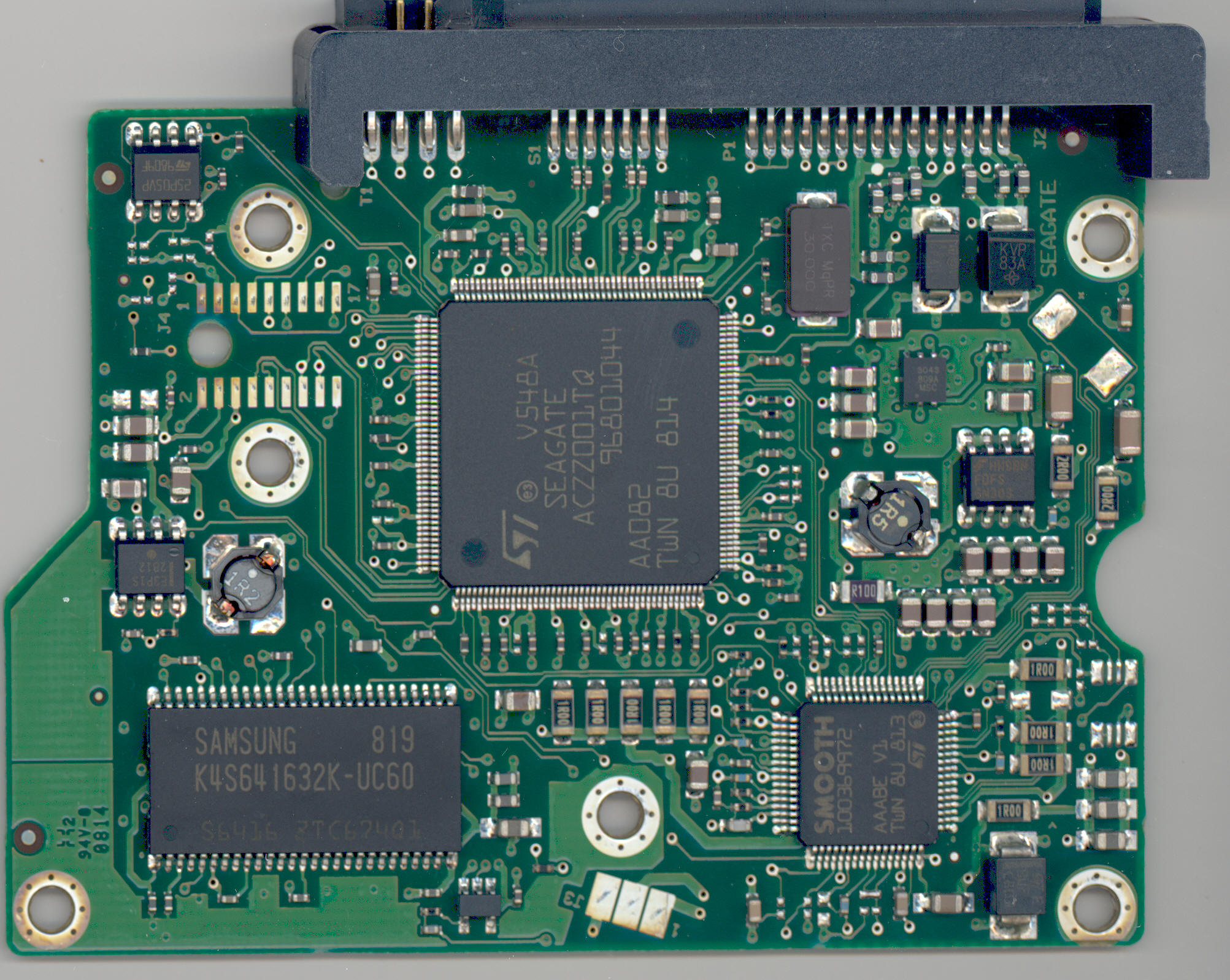
My question was in regard to a VCM servo, ie Voice Coil Motor, not the spindle motor. Hence the reference to Seek Error Rate in the SMART report. In any case, the spindle motor current would be continuously monitored so that the drive could initiate protective action in the event of a failure. "RPM stabilisation" is achieved by monitoring the back EMF of the motor windings. The embedded "servo information" provides the data clock.
Here is a datasheet for the ST Microelectronics L7250 SMOOTH VCM and spindle motor controller:
http://wandrew.regruppa.ru/PCInfo/TechDoc/L7250(Smooth).pdf
On page 21 it states that "the system is phase locked to the motor by sensing one BEMF zero crossing on one winding, once per electrical cycle. A window is opened up in that winding, and it is tri-stated to allow sensing of the zero crossing."
If one head were weak, or one zone damaged, then one would expect to see read errors. However, the SMART read error rate attribute is showing a cooked value of 114 which is excellent. Furthermore, if a zone were damaged, then the access time would spike at that point, yet the following graph is fairly linear across the entire surface:
http://img255.imageshack.us/img255/9105/hdtune2um0.jpgBTW, the drive is not mine, and I expect that it was RMA'ed a year ago. In any case you have missed the point of my post. It is not only about "_issing resistors", it is about understanding how things work, and whether changing boards is really as straightforward as it appears. Judging by the response to my post, it is clear that nobody has noticed the difference, and moreover nobody understands the difference when it is pointed out to them.
A common manufacturing technique is to include several resistors in parallel and to trim the output of the circuit by removing one or more of these resistors. This is referred to as "select on test" and avoids the use of relatively expensive and potentially unreliable trimpots.
In the manufacture of DVD players, for example, a manufacturer will use the one decoder board with several brands of DVD loader. Each loader requires different drive levels for the tray motor, spin motor, and sled motor. These may be programmed by resistors, or accounted for in a software module.
In the present case it could be that the HD was manufactured with two alternative VCM actuators. The SMOOTH chip detects the voltage across the current sense resistor -- it does not detect the current directly. Increasing the resistance (by removing a resistor) would result in a reduction in the voice coil current which would in turn slow down the actuator. This behaviour is consistent with the slower access times reported by HD Tune. In fact, I believe AAM slows down the voice coil to reduce seek noise, although to a much lesser extent.
As for "bullshit" and "DIY", this whole business of data recovery is essentially DIY, or does BlackST have access to insider manuals that the rest of don't? I may be ignorant (at the moment), but I'm not stupid. Likewise, someone who is knowledgeable (by having access to "first-hand information") may not necessarily be intelligent.
Take a look at HD Tune's SMART report. Notice how many attributes are described as "unknown". That's the nature of this business. In fact HD Tune's author does not appear to be aware that raw SMART data are actually 48-bit numbers, not 32 bits. In particular, Seagate's raw Seek Error Rate attribute stores the number of seeks in the lower 32 bits and the number of seek errors in the uppermost 16 bits. But this is DIY information that I have determined for myself, without reference to insider literature, so maybe it is of no value to BlackST.
In any case, I have made the information available here:
http://en.wikipedia.org/wiki/Talk:S.M.A ... _attributehttp://en.wikipedia.org/wiki/Talk:S.M.A ... Error_RateAnyway I didn't come here to beg for scraps from the master's table. I came to learn and to contribute in any way that I can. I'm over 50 years old and my experience is in the on-site chip level repair of minicomputers and peripherals. I have seen and repaired many servo systems, including those in tape transports, storage module disc drives, plotters, and printers. I have even hacked firmware to alter acceleration profiles in pen plotters. I operated my own third party maintenance and repair business, and have done a lot of reverse engineering, improvisation, and lateral thinking. FWIW, I also have an electrical engineering degree, but I confess that the only good thing about having a degree is that I don't have to worry about not having one.



 FAQ
FAQ Search
 Login
Login Register
 HDDGURU FILES