MultiDrive – free backup, clone & wipe disk utility from Atola Technology

All times are UTC - 5 hours [ DST ]


Post new topic Reply to topic  [ 5 posts ] 
Author Message
 Post subject: Barracuda ES.2 PCB and Head replacement
PostPosted: January 23rd, 2013, 23:56 
Offline

Joined: January 23rd, 2013, 18:54
Posts: 2
Location: Oregon, US
First off I would like to apologize if this topic has been beaten to death but I have searched and searched for all the info I am looking for in numerous forums and found only fragments of what I am looking for at best. I know forum guru's get very frustrated when questions have been repeated.

I have a Barracuda 500GB (4 heads/2 platters) ES.2 that died in what appears to be multiple areas. It is a data only drive (1 of 3 drives on this PC) and I discovered that it was bad when my operating system would not boot up. Looking in the BIOS 2 of my 3 drives were not showing up (they were all the same batch ES.2 drives). One of the drives not showing up being the OS drive, the other being this data drive. After process of elimination I discovered it was this drive that was bringing down my entire PS. After doing some research I found that it could be the 12V TVS Diode that had shorted. I clipped this off, and although my OS drive would now boot with this data drive attached, the data drive still could not been seen in BIOS. At this time I replaced the PCB from another identical drive. Luckily (or not) I have 6 of these drives total, purchased at the same time from the same batch. From what I understand the ROM would need to be swapped out in order for the drive to function properly. More on that later. Even with the replaced PCB, still nothing in the BIOS. I then went on to replace the heads after reading so much about the failures of these particular drives. I know this is very controversial and I have heard many people say the drive is ruined the minute you open up the case. Please assume I am in a clean room. Upon replacement of the heads, with the new PCB, BIOS can now at least see there is something there, but I get the code ST_M13FQBL. The drive spins up, give a series of about 11 evenly spaces clicks and then powers down. If I put the old PCB on the drive with the new heads, the drive give several bursts of about 4 clicks and shuts down.

My questions are as follows:
1: assuming that the heads never touch each other, is it possible to replace the heads without the tools that disengage the heads from the platter without having to slide the heads to the end of the platter. I have seen some expensive tools (only overseas though) that will separate the heads in the park position. Very slick, but I cannot find them anywhere in the states. I have seem some instructors on YouTube slide the heads to the edge (while contacting the platters the whole time) and then separate the heads with varying home made tools for removal. This is what I have done, and although I have been very careful and it seems to go well, I am not sure if this is what my problem is. I have even seen an instructor spin the platter when the new heads are installed to get them to go into the park position. I did this on one attempt and the platters became very resistive as if there was something binding. Did not feel right to me. Any advice?

2. I have seen a head replacement tool from salvationdata.com that may be a decent (and inexpensive) option for head replacement but they don't seem to specify ES.2 (not sure if 7200.11 4 head 2 platter is the same). Would this work, and does any body know if they are a solid company to order from? I had found another one that looked very professional, again overseas, but they wanted around $700 for it and it's very drive specific. As soon as I hopefully get the data off of this drive that's it for the ES.2's for me.

3. Attached is a pic of the ES.2 board (the other pix of 7200.11 and .12 don't look exactly the same) with the numbers 1, 2 and 3 on them. Could someone please tell me which one is the 8-pin ROM that needs to be swapped when replacing the PCB?

4. What should I expect to see/hear if everything was functioning properly, and all that was needed was to swap out the ROM from the old PCB? I'm curious if that may be the only thing giving me the ST_M13FQBL code in the BIOS of if that is a definite sign that I still have head problems?


Finally, I am diligent about backing up and have 99% of my data backed up but I seem to have left out a newly added folder in my backup schedule that I would like to get back. With that said, it is not worth $2k for me to recover, but I would really like the lost data (would save me time recreating), and am willing to spend additional time and some $ on the cause if it is even slightly possible for me to recover the data and learn something along the way. It seems as though I have already spent too much time trying to sift through everyone else's Q&A and decide to cut to the chase and see if anyone could share some of their expertise in this area. Although I am new to the HDD hardware troubleshooting/repair, I am an electrical engineer as well as a fabricator and do have some knowledge and skill-sets when it comes to electronics and mechanics.

Your knowledge on the subject is my appreciated!


"You don't know what you don't know"

Attachment:
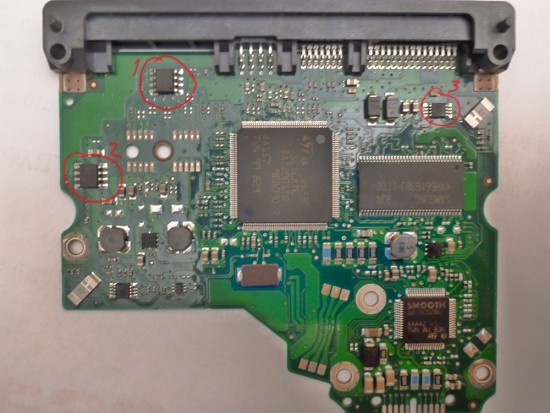
P1040957 copy.jpg
P1040957 copy.jpg [ 546.6 KiB | Viewed 8753 times ]


Top
 Profile  
 
 Post subject: Re: Barracuda ES.2 PCB and Head replacement
PostPosted: January 24th, 2013, 1:25 
Offline
User avatar

Joined: June 8th, 2006, 19:44
Posts: 3144
Location: Atlanta, GA
This is really a "textbook" case of the perils of DIY.

Unfortunately, IMHO, you are way past the point of no return.

I'm not asking a rhetorical question -- I really want to know: When you watched the videos and did your "research", did you not also see the caveats and warnings about making a correct diagnosis; having the proper tools; and the absolute necessity of sufficient knowledge and experience before attempting mechanical repairs?

These so-called "instructors" have a duty -- in my view -- to warn about the risks and perils. It's a shame you were encouraged to further ruin your chances for recovery.

_________________
http://www.datasaversllc.com


Top
 Profile  
 
 Post subject: Re: Barracuda ES.2 PCB and Head replacement
PostPosted: January 24th, 2013, 5:16 
Offline
User avatar

Joined: September 5th, 2010, 12:29
Posts: 1038
Location: South Africa
Touche.

_________________
Death is nothing, but to live defeated and inglorious is to die daily.
Data Recovery Cape Town


Top
 Profile  
 
 Post subject: Re: Barracuda ES.2 PCB and Head replacement
PostPosted: January 24th, 2013, 13:16 
Offline

Joined: January 23rd, 2013, 18:54
Posts: 2
Location: Oregon, US
Thank you for the insightful reply.;) As stated previously, I am diligant about backups but missed something that I would like to have, but I can recreate. It will just take time. Perhaps I should be spending my time doing that instead of attempting to find HELPFUL information from these forums. If it was critical and irreplacable data, I would have taken a much different path but I know going to the pros for data recovery isn't cheap and paying even $500 isn't worth it. I have other projects that already consume plenty of cash.

Yes I knew the potential for failure. I didn't need any warnings to know the potential risks involved. I am not new to electronics as industrial and proprietary electronics are part of every day life. I didn't just "research" off of YouTube. I have been to many sites/forums including this one. I also practiced on several sacrificial drives before even attempting the head replacement. Perhaps I am ignorant and it is in fact rocket science, but it does not seem to be to me.

Lastly, I'm not sure why my diagnosis would be off but would like to know if it was. I am on here to learn, not be scorned and shamed for trying to fix something on my own.;) Start with the simple and most probable, then move to the difficult, right? Afterall, there are really only two key components to these drives... The PCB and the heads. When the PCB replacement still did not yield any positive results (e.g. BIOS still would not even see the drive) I moved onto the heads. After I replaced the heads, BIOS at least saw that there was a physical device there. With the old PCB, the drive was shorting out the power supply. Please tell me where my troubleshooting/diagnosis was faulty, I would like to know. I am not a HDD expert, but I do get paid well as a trusted resource to troubleshoot $100MM pieces of electronic equipment on nearly a daily basis so I do have some confidence in my process of elimination abilities. Although we all make mistakes.


Top
 Profile  
 
 Post subject: Re: Barracuda ES.2 PCB and Head replacement
PostPosted: January 25th, 2013, 0:06 
Offline
User avatar

Joined: June 8th, 2006, 19:44
Posts: 3144
Location: Atlanta, GA
Unfortunately, people always interpret "that's a really bad idea" as a personal attack or arrogance, when it is neither.

An analogy:

I might decide that I wanted to perform, say, my own hernia repair. I scour the internet for as many articles that I can find about surgery, local anesthesia, suturing, sepsis, surgical implements, etc. I then ask in a surgeon's forum for the step-by-step instructions on the process, and am outraged when no one steps up to the plate.

Some additional thought about the matter would bring the realization that knowledge by itself is insufficient, and to attempt to forge so many disciplines that require years and years of training into an hour or two procedure is "a really bad idea" in spite of my desire to do so, and the claim that "hey, it's my own body, I can do with it as I wish." No professional is going to volunteer information that has an extremely high probability of putting you at risk.

The analogy holds for data recovery. While anyone can do a simple fix like removing a TVS (which has its own risks and is a bad idea unless you identify the cause of the TVS failure and make sure that the drive is protected against further electrical assaults), just as you can easily burn off your own warts with glacial acetic acid, head swaps are another matter altogether.

Modern hard drives are incredibly complex devices, using state of the art mechanics with amazingly tight tolerances; signal processing in the Ghz range, and sophisticated electronics and firmware. It takes years of practice to become adept at the various disciplines involved, even for folks with prior unrelated electronic, software, or mechanical experience.

The key to it is proper diagnosis, which you yourself realize, but lack the proper tools and know-how. With Seagate drives, it is essential to use the serial terminal to understand what is going on inside of the drive, before you undertake "surgery."

It's difficult to ascertain remotely what is the problem with your drive, without the benefit of tools or sufficient details. You correctly identified that the TVS had failed.

But after that, it quickly gets complicated. Just so you get an idea:

1) Did your drive click and / or spin down after you removed the TVS, but before you did the head swap? This additional information would help to determine if the event that took out your TVS also killed the preamp, or if something else on the PCB was damaged -- both are possibilities with TVS failure. It's also quite possible that you also had a firmware problem, which didn't require invasive procedure.

2) How did you match the heads that you used to transplant? What criteria did you value?

3) Did you inspect the heads for damage or contamination after you removed them from your drive -- and after you removed them from your donor?

4) Did you "perfect" your head swap technique on known working drives before you attempted this recovery (that's a rhetorical question . . . I already know the answer).

5) The ST_M13FQBL message indicates that the heads are bad. Are they non-functional because you didn't match them, or because you ruined them during the transplant?

6) Did you scratch the platters further, reducing the chances for future recovery attempts?

7) Etc.

There is also some widespread expectation . . . that every detail about hard drive data recovery is to be received simply for the asking. When in fact, a "proper" answer to your question might involve some 50 pages of information, plus photos, illustrations, charts, etc.

Is that too much to expect from strangers who don't want you to screw up your drive, simply because you demand to know?

In my opinion . . . you bet it is!

_________________
http://www.datasaversllc.com


Top
 Profile  
 
Display posts from previous:  Sort by  
Post new topic Reply to topic  [ 5 posts ] 

All times are UTC - 5 hours [ DST ]


Who is online

Users browsing this forum: No registered users and 47 guests


You cannot post new topics in this forum
You cannot reply to topics in this forum
You cannot edit your posts in this forum
You cannot delete your posts in this forum
You cannot post attachments in this forum

Search for:
Jump to:  
Powered by phpBB © 2000, 2002, 2005, 2007 phpBB Group